
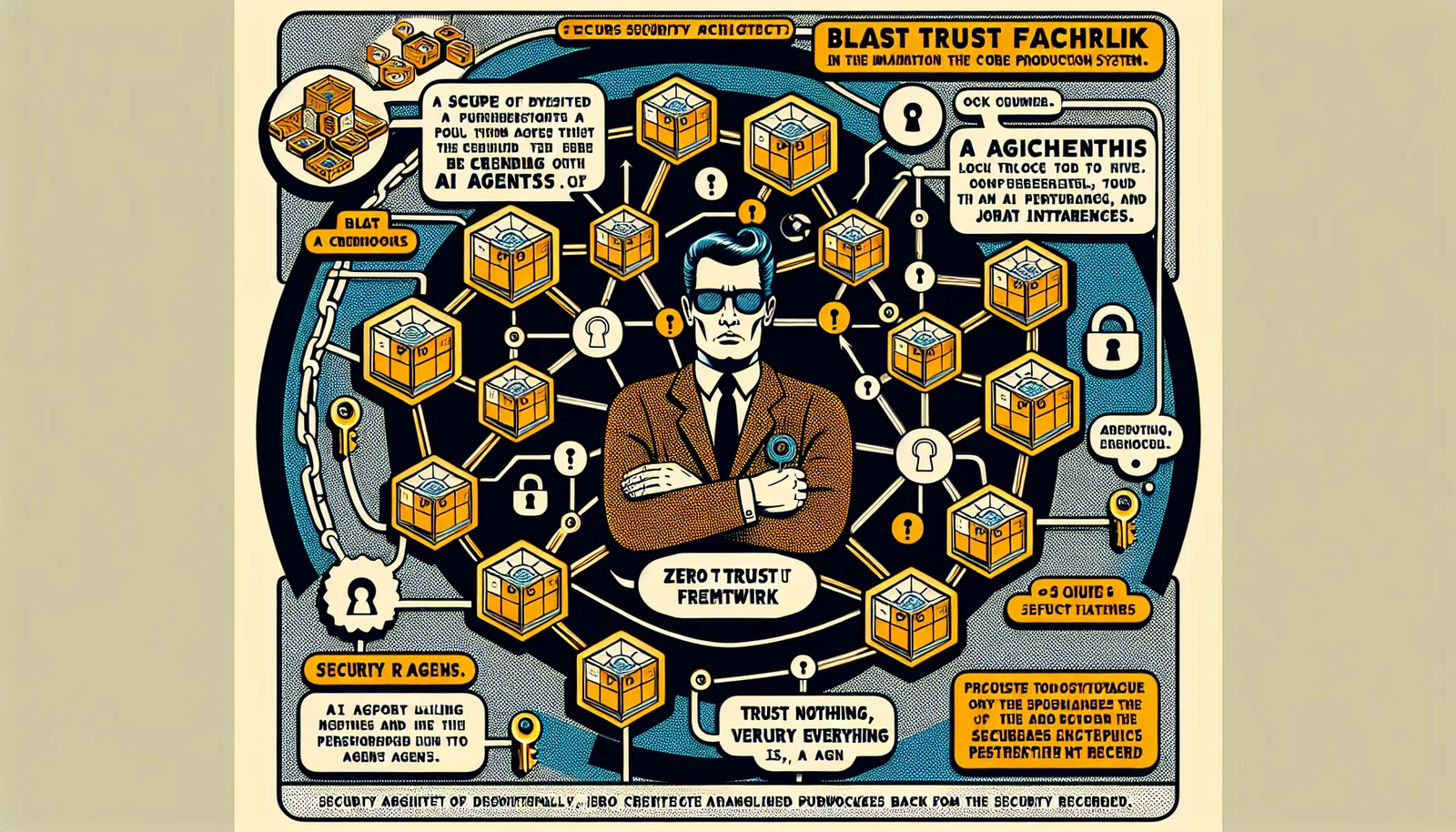
Microsoft's Zero Trust for AI Framework: Securing Agentic Workloads in 2026
Microsoft's ZT4AI framework from RSAC 2026 gives enterprises a principled blueprint for securing AI agents, LLMs, and autonomous AI workloads using Zero Trust architecture.

Enterprises Now Have a Security Blueprint for AI Agents — Microsoft Published It
Security teams deploying AI agents, LLMs, and autonomous AI systems have been navigating architecture questions without a unified framework. Microsoft's announcement at RSAC 2026 of Zero Trust for AI (ZT4AI) changes that. For any organization trying to govern AI deployments with the same rigor applied to human identity and access management, ZT4AI is the most concrete enterprise security framework for agentic AI published to date.
Zero Trust's Three Principles, Applied to AI
ZT4AI takes the foundational Zero Trust principles — Verify explicitly. Apply least privilege. Assume breach. — and applies them specifically to how organizations govern AI agents, LLM deployments, and the infrastructure connecting them.
Verify Explicitly for AI Systems
In traditional Zero Trust, "verify explicitly" means never trusting network location as a credential — every request must be authenticated. For AI agents, it means treating every agent action as requiring fresh authorization rather than inheriting ambient access granted at deployment time.
An AI agent calling an internal API should present verifiable credentials for that specific call. An AI agent reading from a database should authenticate per session, not rely on a permanent service account with broad permissions. This shifts the security model from "we deployed this agent, so it's trusted" to "every action this agent takes requires validated authorization."
Apply Least Privilege to AI Agents
AI agents frequently end up over-provisioned — granted broad access at setup because it was easier than scoping permissions precisely. The ZT4AI guidance is explicit: each AI agent should have access only to the data, tools, and systems required for its specific function, and that access should expire after the task is complete.
A customer service AI agent does not need access to financial systems. A code review AI agent should not have production deployment permissions. A data analysis agent should have read access to the dataset it needs — nothing more. The principle is identical to human least-privilege; the implementation requires AI-specific tooling for authorization.
Assume Breach for AI Workloads
The "assume breach" principle means designing systems to contain failure, not just prevent it. For AI agents, this means:
- Audit logging for every AI agent action — comprehensive trails that make post-incident investigation possible
- Behavioral monitoring — detecting when agents deviate from expected patterns, which may indicate prompt injection, tool poisoning, or scope creep
- Workload segmentation — isolating AI agent infrastructure from core production systems to contain the blast radius of a compromised agent
- AI-specific incident response — documented procedures for prompt injection, model misbehavior, and agent scope violation, not just traditional intrusion response
Microsoft Agent 365: ZT4AI Built In
Alongside the framework, Microsoft announced Agent 365 — an enterprise agentic AI platform available May 1, 2026 at $15 per user per month. Agent 365 implements ZT4AI natively: built-in service identity for AI agents, per-task permission scoping, automated audit logging, and anomaly detection across agent workflows.
The pairing is intentional. ZT4AI is both a published standard and the architecture embedded in Agent 365. Organizations adopting Agent 365 get a ZT4AI-compliant platform out of the box; organizations building their own AI infrastructure get the framework to design toward.
A Checklist for Security Teams
For organizations already deploying AI agents — through enterprise platforms, custom implementations, or developer tooling:
- Inventory your AI workloads: Know what AI agents are running, what they can access, and under what authorization model
- Assign identity to agents: Every AI agent should have its own service principal — not shared credentials with other processes
- Scope permissions per task: Replace permanent broad grants with task-scoped authorization that expires after completion
- Build audit trails: AI agent actions should be logged with the same fidelity as privileged human account activity
- Update incident response playbooks: Add AI-specific scenarios — prompt injection, tool poisoning, and agent scope violation — to existing IR procedures
The ZT4AI framework is freely available and vendor-agnostic. Every organization deploying AI agents in production should have it on the security team's reading list.
Sources: Microsoft RSAC 2026 Announcement (April 2026), SimonCarter.ai (April 2026), Dark Reading (April 2026), Channel Insider (April 2026), SecurityWeek (April 2026)
More Ai Security Stories

Thales Sentinel Envelope Plus: Shielding Code From AI Agents
Thales Sentinel Envelope Plus hardens compiled apps against AI reverse engineering. In tests, an AI agent found 0 of 10 bugs after using 970x more tokens.

Android 17 Advanced Protection: 6 New Anti-Spyware Defenses
Android 17 Advanced Protection adds 6 new defenses, including Intrusion Logging with 12 months of encrypted logs and USB lockdown. Here's how each works.

Legit Security Agent Auto-Fixes Vulnerable Dependencies
Legit Security's agentic remediation now fixes vulnerable open-source dependencies, re-scans before and after, and opens a pull request for review.