
Microsoft Open-Sources the Agent Governance Toolkit: Runtime Security for Every AI Agent You Deploy
Microsoft's Agent Governance Toolkit is open-source runtime security for AI agents — covering all 10 OWASP agentic AI risks at sub-millisecond enforcement.

Runtime Security: The Gap AI Agent Deployment Has Been Missing
Deploying AI agents in production is a fundamentally different security challenge than deploying traditional software. Traditional applications execute deterministic code paths that security teams can audit, test, and trust. AI agents make autonomous decisions about what actions to take, which tools to call, and what data to access — in response to inputs that can't be fully predicted in advance. The security model has to be different.
Microsoft's Agent Governance Toolkit, released April 2, 2026 under the MIT license on GitHub, is designed specifically around the OWASP Agentic AI risk framework. It places a policy enforcement engine between any AI agent and the systems it can interact with — checking every action before execution at sub-millisecond latency.
Seven Packages, One Security Layer
The toolkit is structured around seven specialized packages that together provide comprehensive runtime governance:
Agent OS is the core policy engine: stateless, intercepting every agent action before execution at a measured p99 latency under 0.1 milliseconds. It's designed to be transparent to the agent while enforcing governance rules deterministically.
Agent Mesh handles identity and trust between agents. Cryptographic identity uses Decentralized Identifiers (DIDs) with Ed25519 signing. The Inter-Agent Trust Protocol (IATP) governs secure agent-to-agent communication, while a dynamic trust scoring system ranks agent trustworthiness on a 0 to 1000 scale across five behavioral tiers.
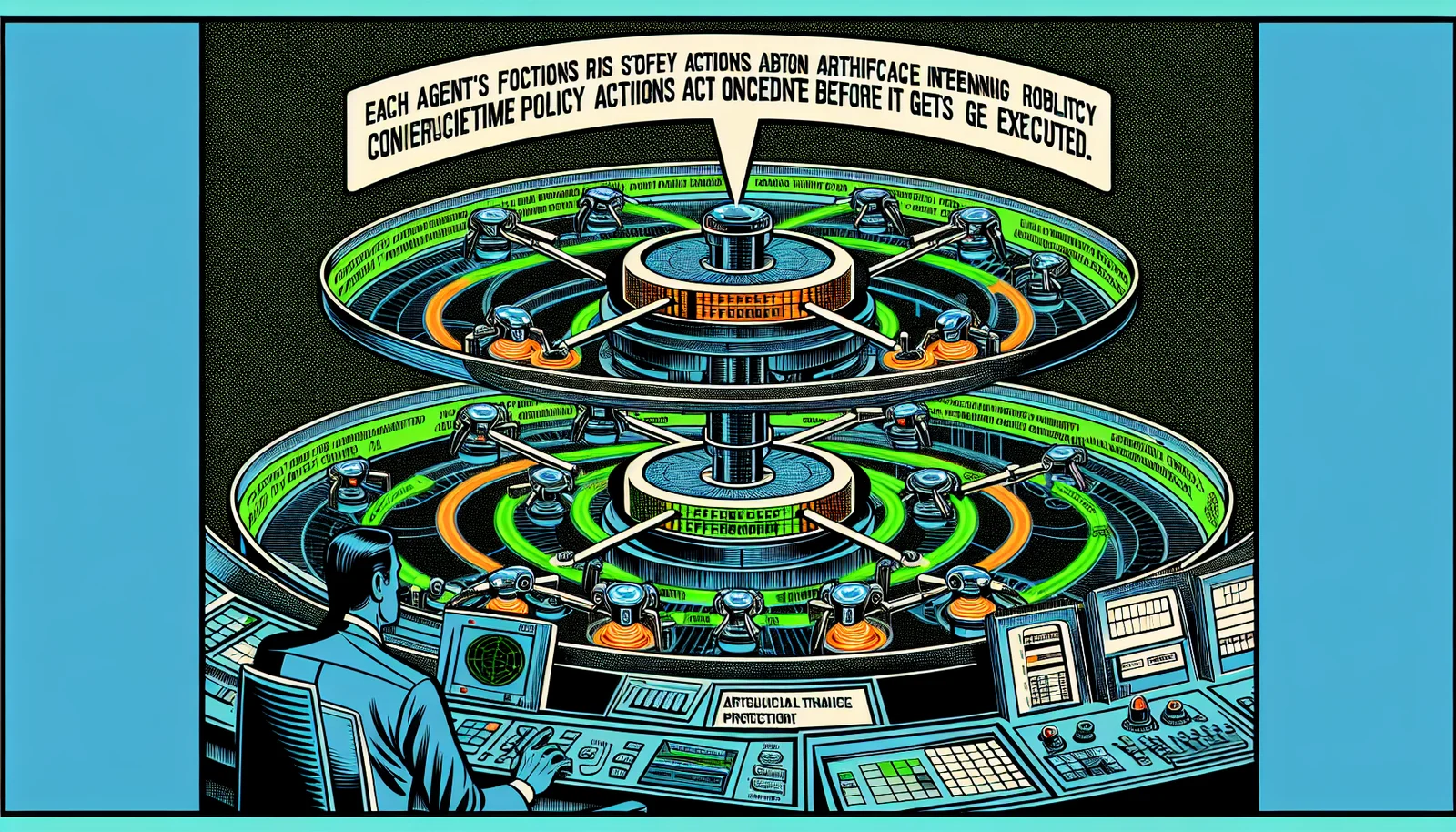
Agent Runtime provides execution rings inspired by CPU privilege levels, saga orchestration for multi-step transactions, and a kill switch for emergency agent termination. In a production AI agent deployment, a reliable hard stop is a fundamental safety requirement — and the toolkit ships one.
Agent SRE applies Site Reliability Engineering discipline to AI agents: SLOs, error budgets, circuit breakers, chaos engineering, and progressive delivery. These are mature production reliability practices that most AI agent deployments currently handle ad hoc, if at all.
Agent Compliance automates governance verification with compliance grading mapped to the EU AI Act, HIPAA, and SOC2. As regulatory requirements for AI systems crystallize in 2026, built-in compliance reporting becomes a deployment requirement rather than an afterthought.
Agent Marketplace manages plugin and tool lifecycle with Ed25519 signing, manifest verification, and trust-tiered capability gating — ensuring that the tools an agent has access to are authorized, verified, and scoped appropriately.
Agent Lightning governs reinforcement learning training workflows with policy-enforced runners and reward shaping, extending governance to the training pipeline itself.
Framework-Agnostic by Design
The toolkit integrates with the frameworks AI developers are already using: LangChain's callback handlers, CrewAI's task decorators, Google ADK's plugin system, and Microsoft Agent Framework's middleware pipeline. If you're building with any of these, Agent Governance Toolkit drops into your existing architecture without requiring a rebuild.
Available in Python, TypeScript, Rust, Go, and .NET.
Why This Matters for AI Security in 2026
Until the Agent Governance Toolkit, there was no single open-source implementation addressing all 10 OWASP agentic AI risks with production-ready enforcement. That gap has been a genuine problem for security teams trying to govern AI agent deployments with the same rigor they apply to the rest of their infrastructure stack.
Microsoft's decision to open-source this framework under MIT signals an understanding that security infrastructure is most effective when it becomes a baseline the entire ecosystem builds on, rather than a proprietary advantage for a single vendor. For defenders building AI agent pipelines, the toolkit is available and production-ready now.
Sources: Microsoft Open Source Blog (April 2, 2026), Help Net Security (April 3, 2026), Phoronix (April 2026), Microsoft Community Hub (April 2026)
More Ai Security Stories

Pwn2Own Ireland 2026 Results: 98 Zero-Days, AI Tools Tested
Pwn2Own Ireland 2026 paid researchers $1,262,000 for 98 zero-days in phones, smart home gear and AI tools, all reported to vendors under a 90-day deadline.

Anthropic OSS Scanner: Free AI Bug Scans for Open Source
Anthropic's OSS Scanner gives open-source maintainers free AI vulnerability scans with fixes; 85 of 97 tested severe findings met its disclosure bar.

What Is Prompt Injection? A Plain-English Defense Guide
What is prompt injection? Learn direct vs indirect attacks, 9 real scenarios, and the 7 OWASP-backed defenses that keep AI assistants and agents safe.