
Mercedes-Benz Open-Sources ARDEP: An STM32 Motor-Control Dev Board
Mercedes-Benz just released ARDEP V2, an Apache 2.0 open-source hardware platform built on an STM32G474 for real automotive-grade motor control.

Mercedes-Benz Drops ARDEP Into the Open-Source Hardware World
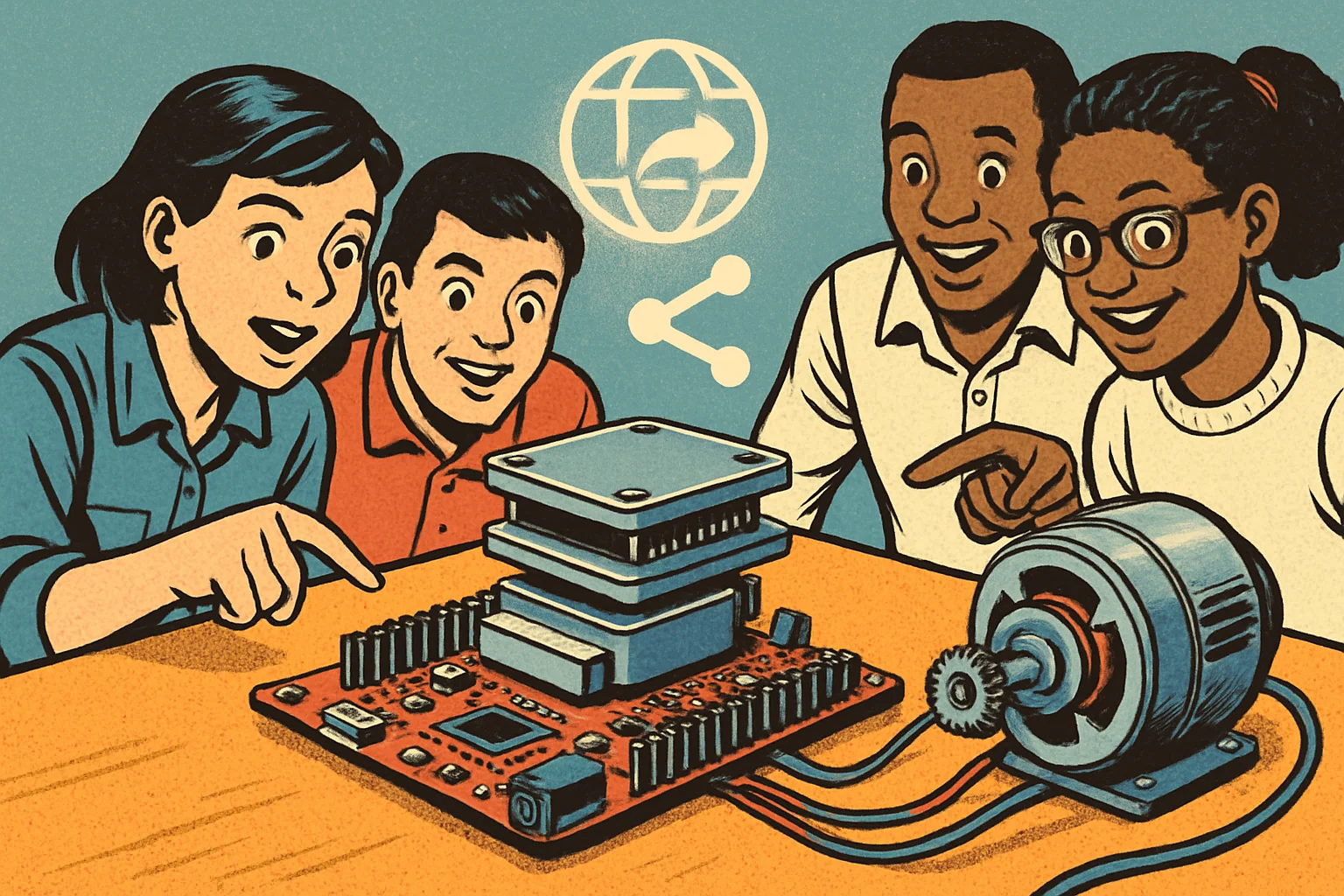
I love it when a big name shows up to the open-hardware party with something genuinely useful, and this one made my week. Mercedes-Benz has open-sourced ARDEP, the Automotive Rapid DEvelopment Platform, now at V2. It is a real motor-control dev board plus a stacking PowerIO Shield, and the whole thing lands under a permissive Apache 2.0 license on Mercedes-Benz's own GitHub. For students, researchers, and makers who have always wanted to poke at automotive-grade motor control, this is a proper open-source hardware gift.
What makes me happy is the intent here. This is not a locked-down reference design you can only admire from a distance. It is schematics, layout, and firmware-friendly hardware you can actually build on, fork, and learn from.
The STM32 At the Heart of the Board
Let me get to the specs, because the silicon choice is excellent. ARDEP is built around an STMicroelectronics STM32G474VE, an Arm Cortex-M4F core running at 170 MHz. This is a part I already respect for motor work, and the reason is its math accelerators: it carries both a CORDIC unit for fast trigonometric functions and an FMAC block for filtering and multiply-accumulate operations. If you have ever hand-tuned a field-oriented control loop, you know those blocks earn their keep, offloading the heavy math so your control loop stays tight and deterministic.
On-chip you get 128 KB of SRAM and 256 KB of flash. That is a comfortable envelope for a serious FOC firmware, sensor handling, and a communications stack without feeling cramped.
Why the G474 Is a Smart Pick
The STM32G4 line was designed with digital power and motor control in mind, so pairing it with an open dev board is a natural fit. You get high-resolution timers and the accelerators above, which is exactly the toolkit for driving an inverter stage cleanly.
CAN-FD, LIN, and High-Voltage I/O for Real Motor Control
This is where ARDEP feels distinctly automotive rather than hobby-generic. The platform includes CAN-FD and LIN transceivers on board, the two buses you actually meet in a vehicle. That means you can prototype nodes that talk the way real automotive subsystems talk, at flexible data rates, instead of bolting on adapters later.
The PowerIO Shield adds configurable high-voltage I/O aimed squarely at motor-control development. Stacking a dedicated power board above the controller keeps the sensitive digital section clean while giving you the beefier interface you need to drive and sense a motor. It is a tidy, honest hardware split.
Open Hardware Everyone Can Actually Use
Here is the part I want to underline. A major automaker publishing a motor-control platform under Apache 2.0 is a real contribution to the commons. Apache 2.0 is friendly and predictable, with an explicit patent grant, so a university lab or a solo maker can study it, adapt it, and even build products without wrestling a restrictive license.
For learning, this is close to ideal. You get an automotive-grade STM32 dev board, genuine bus support, and a documented power stage to experiment with. Mercedes-Benz gets fresh eyes and community goodwill. That is the open-source hardware flywheel working exactly as it should, and I am here for every rotation of it.
Sources: CNX Software — "Mercedes-Benz hosts open-source hardware Automotive Rapid DEvelopment Platform (ARDEP)" — July 7, 2026; Mercedes-Benz GitHub — ARDEP repository — July 2026.
More Mini Computers Stories

Raspberry Pi Desktop for PC and Mac: Revive an Old Laptop
Raspberry Pi Desktop returns for PCs and Intel Macs on 64-bit Debian Trixie, runs live from USB, and installs free on machines up to about 15 years old.

ESP32 SDR Firmware: Turn a Dev Board Into a Radio Scanner
A hidden ESP32 mode lets free ESP-SDR firmware capture raw radio from 2.2 to 2.7 GHz, and 4.8 to 6 GHz on the ESP32-C5, at up to 80 MSa/s. Here is how.

Framework Desktop 192GB: Price, Specs and Ship Date
The Framework Desktop now offers 192GB of memory with the Ryzen AI Max+ PRO 495, from $6,799 DIY, shipping in November. Here are the specs to know.