
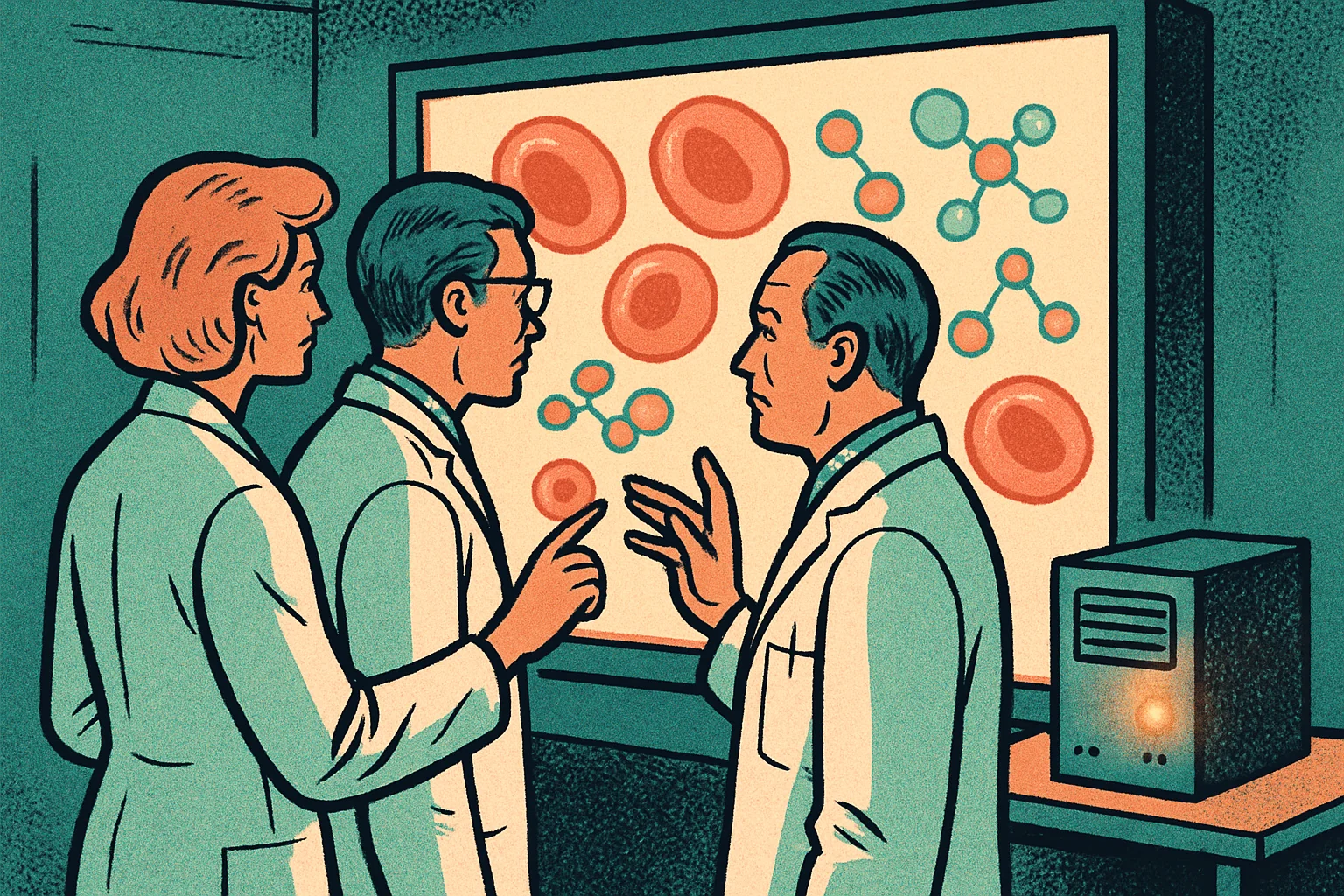
A Local AI Agent Matches Tumor Boards on Blood-Cancer Decisions
A peer-reviewed Nature Medicine study shows a locally run LLM agent matching expert hematology tumor boards while keeping patient data private on-site.

An AI Assistant That Earns a Seat at the Table
Every so often a study lands that shows AI doing something genuinely useful and doing it responsibly. Published in *Nature Medicine* on June 30, 2026, one such paper describes a locally deployable, case-grounded large language model agent that reached high concordance with expert hematology tumor boards — the specialist panels that decide how to treat blood cancers.
Let me unpack the setup, because the details are what make it credible. A tumor board is a group of physicians who meet to review a patient's case and agree on a treatment plan. Matching their collective judgment is a high bar. It requires synthesizing lab results, pathology, genetics, and clinical history into a coherent recommendation.
Validated the Hard Way
What elevates this from a demo to a result is the rigor of the evaluation. The agent was tested across three stages: a retrospective review of past cases, an external validation on data from a different source, and — most demanding — a prospective evaluation where it weighed in on real cases in real time. Clearing all three is exactly the kind of multi-stage validation that separates a promising prototype from something a clinician might actually trust.
The phrase "case-grounded" is doing important work here. Rather than answering from general medical knowledge alone, the agent reasons over the specific patient's actual case materials. That grounding is what keeps its recommendations tethered to the person in front of the doctor, not to a statistical average.
Privacy by Design, Not as an Afterthought
Here is the design choice I find most quietly important: the model runs locally. Because it is deployable on a hospital's own hardware, sensitive patient data never has to leave the building to be processed in someone else's cloud.
In healthcare, privacy is not a nice-to-have; it is a precondition. A brilliant clinical tool that requires uploading confidential records to an outside service faces steep, appropriate resistance. By running on-premises, this agent sidesteps that entire category of concern. It is a reminder that where the computation happens is as much a part of responsible AI as how accurate it is.
A Tool for Clinicians, Not a Replacement
I want to be careful about how I frame this, because the responsible reading matters. This is an assistive system. It supports oncologists on complex, high-stakes decisions; it does not replace the tumor board's judgment. The value is in giving busy specialists a well-reasoned, case-specific second opinion that is available on demand and consistent every time.
Think of it as a tireless colleague who has read the whole file and is ready to talk through the options — while the human experts remain firmly in charge of the call.
Why This Direction Is So Encouraging
What makes this study a genuine bright spot is that it hits every note we want from medical AI at once: peer-reviewed rather than press-released, validated prospectively rather than only on old data, privacy-preserving by architecture, and clearly assistive rather than autonomous. That is the template for how AI earns its way into medicine — carefully, transparently, and in service of the people already doing the work.
Sources: Nature Medicine (June 30, 2026); Clinical Trial Vanguard analysis (June 30, 2026).
More AI Stories

Strands Decider 2B: What Amazon's Free Decision Model Does
Strands Decider 2B is a free 2B-parameter decision model that picks options in about 115ms on a single GPU. Here is how it works and where it fits.

Meta Muse Gadgets SDK: Build Your Own AI Agent Hardware
Meta's open-source Muse Gadgets SDKs bring its Muse agent to Raspberry Pi and ESP32 builds, and 5,000 free Home Link dongles are going to subscribers.

AstaBrief 8B: Ai2's Open Model for Cited Science Reports
AstaBrief 8B is Ai2's Apache 2.0 open model that writes cited research reports in 51 seconds, 3.5x faster than its Claude pipeline. Here is how it works.