
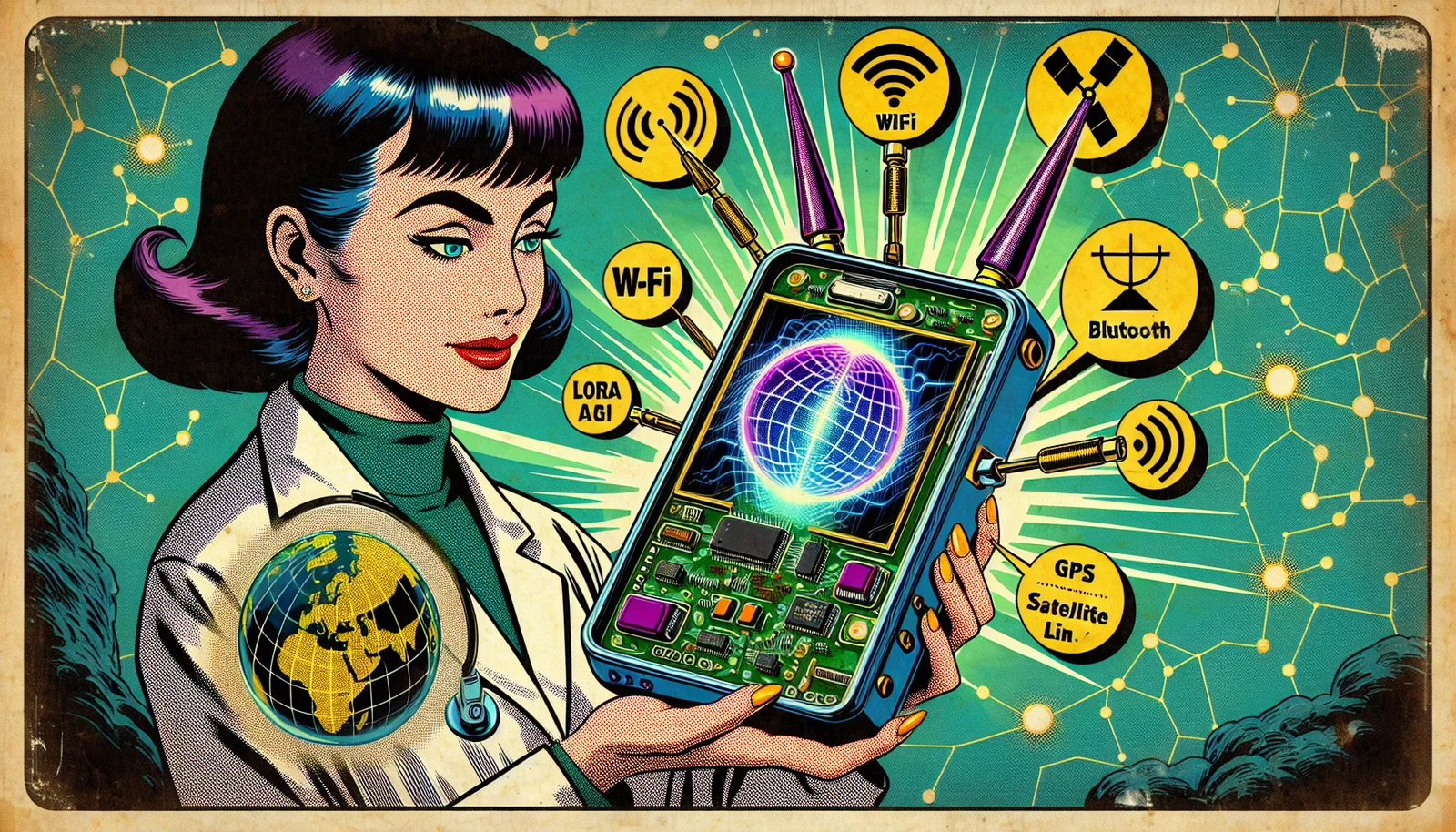
LILYGO T-Display-P4 Packs GPS, LoRaWAN, and Ethernet Into a Smartphone-Style ESP32 Dev Board
LILYGO's new T-Display-P4 combines the ESP32-P4 RISC-V chip with GPS, LoRa radio, Wi-Fi 6, Ethernet, and a crisp 4-inch touch display in a hacker-friendly handheld launching today.

A Dev Board That Does Nearly Everything in One Package
LILYGO has been building compact, feature-packed developer hardware for years, and the T-Display-P4 — detailed by CNX Software on March 31, 2026 — is arguably the most ambitious single board they have shipped yet. It combines the raw processing power of Espressif's ESP32-P4 RISC-V chip with a wireless ESP32-C6 co-processor, a LoRa radio, GPS, Ethernet, and a 4-inch touchscreen display, all in a smartphone-inspired handheld form factor. For embedded developers who usually assemble that list of features across three or four separate boards, this is a compelling integration.
The Hardware Breakdown: What's Under the Hood
The T-Display-P4 centers on the ESP32-P4, which carries a dual-core RISC-V main processor clocked at up to 360–400 MHz alongside a low-power RISC-V core running at 40 MHz for background tasks. That architecture is meaningfully more capable than previous ESP32 variants for compute-intensive workloads — local inference, image processing, signal analysis — while the low-power core manages energy overhead during standby.
Wireless connectivity comes from an onboard ESP32-C6 co-processor handling Wi-Fi 6 and Bluetooth 5.3. That is a useful separation: the ESP32-P4 handles application processing while the C6 manages radio stacks, avoiding the performance interference you get when a single chip handles both. The board also includes 802.15.4 wireless — the foundation for Thread and Zigbee mesh protocols — opening home automation and sensor mesh use cases.
The LoRa transceiver (SX1262 or LR2021 at 830–945 MHz) adds long-range, low-bandwidth radio for IoT deployments where devices need to communicate across distances Wi-Fi or Bluetooth could not cover. The L76K GNSS module provides full multi-constellation positioning including GPS and GLONASS. A 10/100 Ethernet port rounds out the wired connectivity — useful in industrial or fixed-location deployments where wireless is unavailable or impractical.
Display, Memory, and Expansion
The T-Display-P4 ships in two configurations: a 4.05-inch IPS capacitive touchscreen with a front-facing 2MP camera, or a 4.1-inch AMOLED with a rear-facing 2MP camera. Both are multitouch capable.
Memory and storage are well-provisioned: 32MB PSRAM and 16MB NOR flash for the ESP32-P4, plus a microSD slot for expanded storage. Beyond that, the board includes a 9-axis IMU for motion sensing, built-in speaker and microphone with a 3.5mm audio jack, an X-axis linear motor for haptic feedback, GPIO expansion header, and two Qwiic connectors for external sensor attachment. This is a board designed to be useful out of the box without forcing accessory sourcing for common peripherals.
Pricing and Practical Fit
The T-Display-P4 is available now on AliExpress at approximately $111 for the IPS TFT version and $136 for the AMOLED variant — both with the SX1262 LoRa transceiver included. Assembling equivalent functionality from separate modules would cost more and require considerably more integration work.
For projects that need long-range wireless communication, location awareness, and a rich display interface in a self-contained form factor, the T-Display-P4 eliminates significant wiring and debugging overhead. Makers building field data loggers, remote monitoring devices, portable IoT controllers, or smart tracking systems will find this board covers nearly every requirement without reaching for a second PCB.
Sources: CNX Software (March 31, 2026), LILYGO Wiki (2026), Liliputing (March 2026), Hackster.io (March 2026), LinuxGizmos (March 2026)
More Mini Computers Stories

Raspberry Pi Net Zero: How Pi Towers Swapped Gas for Pis
Raspberry Pi replaced a £150,000 building system with a £7,800 Pi-based one at Pi Towers, cut gas entirely in June 2026, and targets net zero in 2027.

Q8botOne Robot Dog: A Palm-Sized Open ESP32-C3 Quadruped
Q8botOne is a palm-sized open-source robot dog with an ESP32-C3 brain and 8 DYNAMIXEL actuators, from $199 as a kit or $599 assembled on Crowd Supply.

Surface RTX Spark Dev Box: Is a $5,999 AI Box Worth It?
Microsoft opened Surface RTX Spark Dev Box pre-orders at $5,999: 128GB unified memory, up to 1 petaflop FP4, and support for 120B-plus parameter models.