
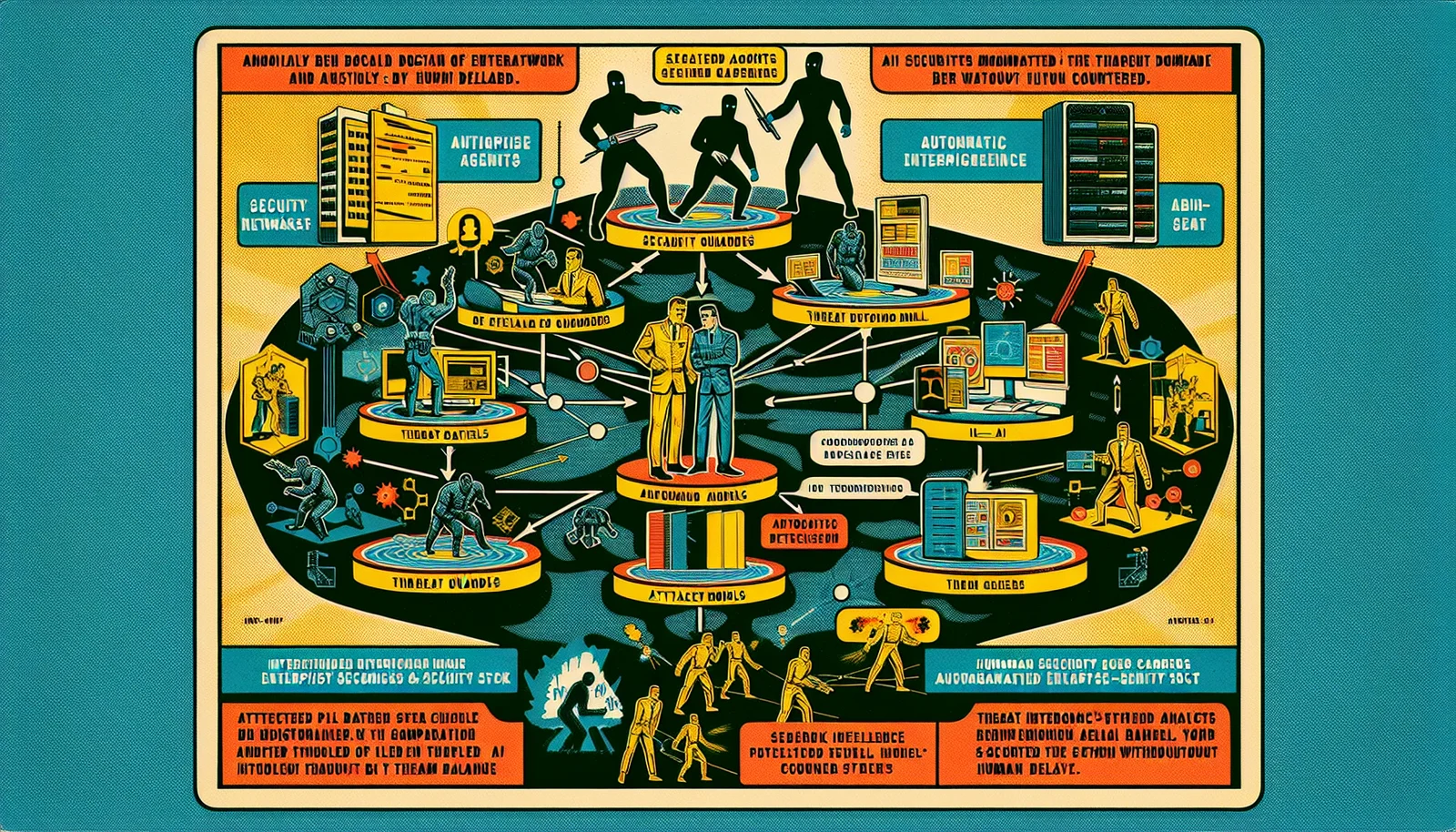
IBM Autonomous Security Uses Multi-Agent AI to Fight Back Against Agentic Cyberattacks
IBM Autonomous Security coordinates multi-agent AI across your full security stack to detect, analyze, and contain agentic cyber threats at machine speed.

IBM Fights Agentic Cyber Threats With Agentic Defense
The cybersecurity arms race has entered a new phase: attackers are using frontier AI models to accelerate every stage of the attack lifecycle — reconnaissance, phishing, exploit development, lateral movement. IBM's response, announced on April 15, 2026, is IBM Autonomous Security: a multi-agent security service designed to operate at machine speed against machine-speed threats.
The core premise is straightforward and compelling: if attackers are using AI to move faster than human security teams can respond, the only practical defense is AI-coordinated response that does not wait for a human to authorize every action.
How IBM Autonomous Security Works
IBM Autonomous Security is built around interoperable AI agents that can operate across an organization's full security stack — spanning multiple vendors, tools, and environments — without requiring everything to be unified in a single platform. The vendor-agnostic design is significant: most enterprise security environments involve ten or more separate tools from different vendors, and the gaps between them are where attackers find their paths.
The coordinated agents work together to:
- Analyze software exposures and runtime environments to identify and map exploit paths before attackers reach them
- Enforce security policies consistently across connected tools, closing the policy drift that manual management inevitably creates
- Detect anomalies in real time across network traffic, endpoint behavior, and identity activity simultaneously
- Contain threats autonomously, with minimal human intervention required for routine containment actions and automatic escalation for decisions requiring human judgment
The "coordinated decision making" framing matters. IBM's architecture does not simply run multiple agents in parallel — it coordinates them so that each agent's findings inform the others' analysis. An anomaly detected by a network agent can trigger a deeper investigation by the identity agent without an analyst needing to manually connect those findings.
The Enterprise Agentic Readiness Assessment
Alongside Autonomous Security, IBM Consulting is offering a new cybersecurity assessment designed specifically for the agentic threat era. The assessment provides organizations with:
- Visibility into security gaps and policy weaknesses specific to their environment
- Identification of AI-specific exposures — the attack surfaces unique to organizations that have deployed AI tools internally
- Mapping of potential exploit paths through AI systems and agent integrations
- Prioritized mitigation guidance with interim safeguards where no immediate software fix exists
For enterprises deploying AI agents across their operations, this assessment addresses a genuinely emerging concern: AI-to-AI attack vectors, where a threat actor's AI model targets vulnerabilities in an organization's own AI systems and integrations, are becoming a real threat category.
Why IBM Launched This Now
IBM's announcement cited a clear threat escalation: attackers leveraging frontier AI models can dramatically lower the time, cost, and expertise threshold for executing sophisticated, targeted attacks. The manual, alert-driven security workflows that were adequate even two years ago are increasingly unable to keep pace.
Organizations still running primarily human-reviewed security processes face a widening speed disadvantage against AI-assisted attackers. IBM Autonomous Security is an attempt to restore that balance by putting coordinated AI defense at the center of the enterprise security stack — not as a supplementary tool but as the primary operating layer.
For security teams evaluating how to update their SOC operations for the AI-accelerated threat landscape, IBM's multi-agent approach represents a concrete implementation of coordinated autonomous defense that the industry has been theorizing about.
Sources: IBM Newsroom (April 15, 2026), ITOps Times (April 2026), MSSP Alert (April 2026), BusinessWorld Online (April 22, 2026)
More Ai Security Stories

Thales Sentinel Envelope Plus: Shielding Code From AI Agents
Thales Sentinel Envelope Plus hardens compiled apps against AI reverse engineering. In tests, an AI agent found 0 of 10 bugs after using 970x more tokens.

Android 17 Advanced Protection: 6 New Anti-Spyware Defenses
Android 17 Advanced Protection adds 6 new defenses, including Intrusion Logging with 12 months of encrypted logs and USB lockdown. Here's how each works.

Legit Security Agent Auto-Fixes Vulnerable Dependencies
Legit Security's agentic remediation now fixes vulnerable open-source dependencies, re-scans before and after, and opens a pull request for review.