
Firmus Raises $2B for Renewable-Powered AI Factories
Firmus closed a fully subscribed $2 billion round at a $10.5 billion valuation to build renewable-powered AI data centers across Asia-Pacific.

Firmus announced on August 7, 2026 that it had fully subscribed a $2 billion strategic equity investment at a post-money valuation above $10.5 billion, capital earmarked for accelerating its Australian AI factory rollout and preparing expansion across the wider Asia-Pacific region. The investor list is the tell: follow-on participation from NVIDIA and Coatue, new money from funds managed by Blackstone Tactical Opportunities and other Blackstone vehicles, plus participation from Jane Street.
- Fully subscribed $2 billion equity round announced August 7, 2026
- Post-money valuation above $10.5 billion
- Investors include NVIDIA, Coatue, Blackstone Tactical Opportunities vehicles, and Jane Street
- Capital accelerates Project Southgate in Australia plus early development of an Indonesian AI infrastructure project
Why Energy Strategy Is Now Part of the Compute Story
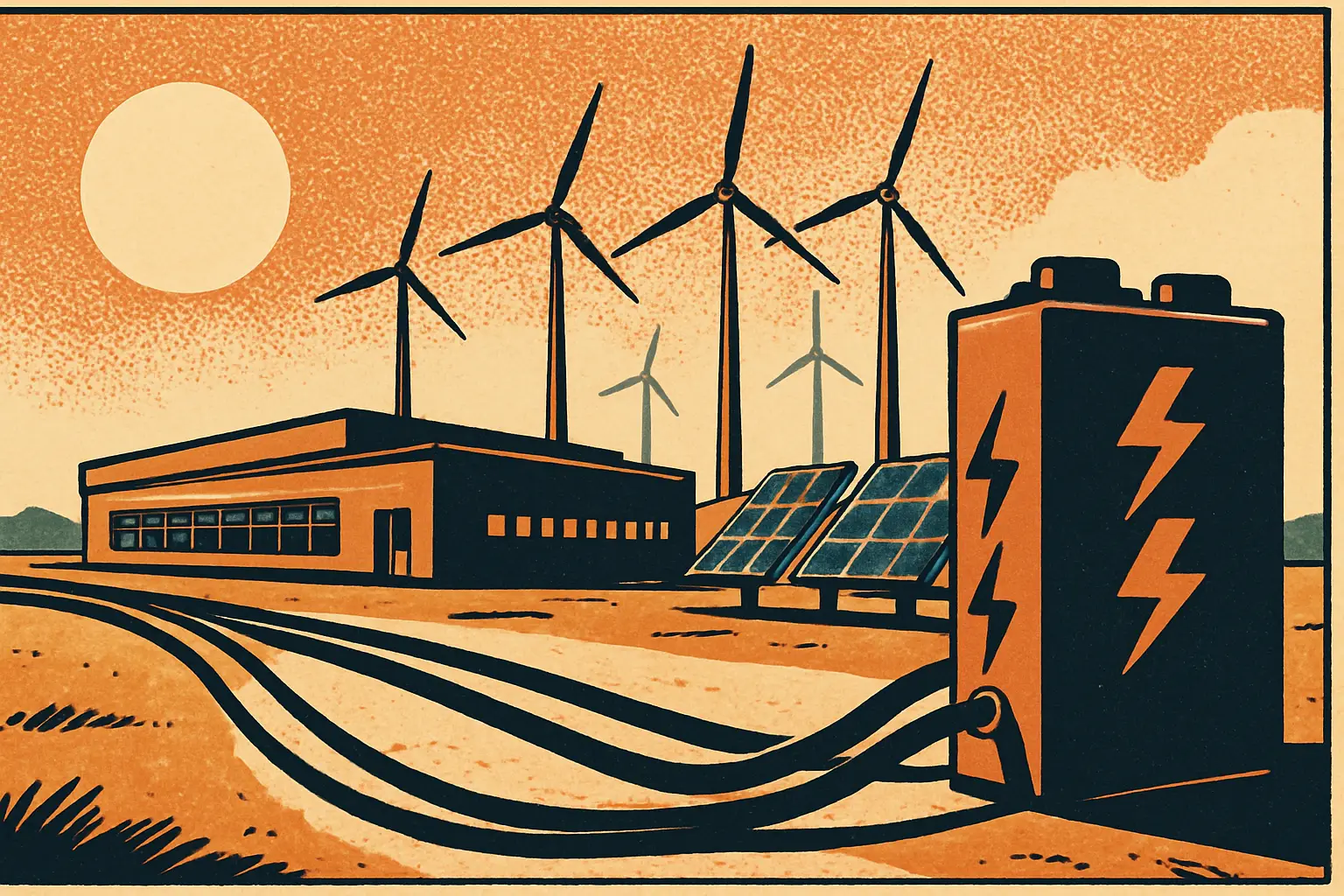
The most interesting detail in this round is not the valuation. It is that Firmus has separately committed to a 600-megawatt wholesale energy agreement in South Australia, linked to 1.2 gigawatts of new renewable generation and 1.5 gigawatt-hours of battery storage. That is a facility operator treating power procurement as a core competency rather than a line item.
The reasoning is straightforward once you look at the arithmetic of a modern accelerator hall. Energy is the dominant operating cost of AI training at scale, and unlike silicon, it cannot be ordered from a single vendor and shipped. Locking in generation capacity years ahead, and pairing it with storage that lets the site participate in grid balancing rather than simply drawing from it, converts the largest variable cost into something closer to a fixed one. Firmus has described its facilities as designed to operate on renewable energy with reduced water usage, with grid participation built into the model.
What Does an AI Factory Mean in Practice?
The phrase gets used loosely, so it is worth being precise. An AI factory is a purpose-built facility optimized end to end for training and serving large models — high-density racks, liquid cooling, high-bandwidth interconnect fabric, and a power envelope sized for sustained near-peak draw rather than the bursty profile of a general-purpose cloud region. It is closer to an industrial plant than to a traditional colocation hall.
Building these in Australia and Indonesia rather than the usual North American and European corridors is a deliberate bet on regional demand and, just as importantly, on regional energy availability. Australia has abundant solar and wind resources and a grid actively integrating storage, which is a genuinely good match for a load that is large, predictable, and somewhat schedulable.
The Infrastructure Layer Keeps Compounding
This is the second major capital event in the AI physical layer we have covered recently, and the pattern is consistent: the constraint on frontier AI has shifted from model architecture to the concrete, copper, and kilowatts underneath it. Our AI coverage has tracked the same shift from the silicon side, most directly in AMD's data center revenue doubling to $6.7 billion, and it shows up again in the optical interconnect demand driving component makers.
What is encouraging about the Firmus approach specifically is that the sustainability framing appears to be structural rather than promotional. A 600-megawatt supply agreement tied to new generation and battery capacity is a commitment with a balance-sheet consequence, not a press release. If the pattern holds — new AI capacity arriving alongside new renewable generation instead of competing with existing supply — it is a considerably better outcome for everyone sharing the grid.
Sources: Firmus Newsroom — August 7, 2026; Bloomberg — August 7, 2026; Tech Startups — August 7, 2026.
More AI Stories

Strands Decider 2B: What Amazon's Free Decision Model Does
Strands Decider 2B is a free 2B-parameter decision model that picks options in about 115ms on a single GPU. Here is how it works and where it fits.

Meta Muse Gadgets SDK: Build Your Own AI Agent Hardware
Meta's open-source Muse Gadgets SDKs bring its Muse agent to Raspberry Pi and ESP32 builds, and 5,000 free Home Link dongles are going to subscribers.

AstaBrief 8B: Ai2's Open Model for Cited Science Reports
AstaBrief 8B is Ai2's Apache 2.0 open model that writes cited research reports in 51 seconds, 3.5x faster than its Claude pipeline. Here is how it works.