
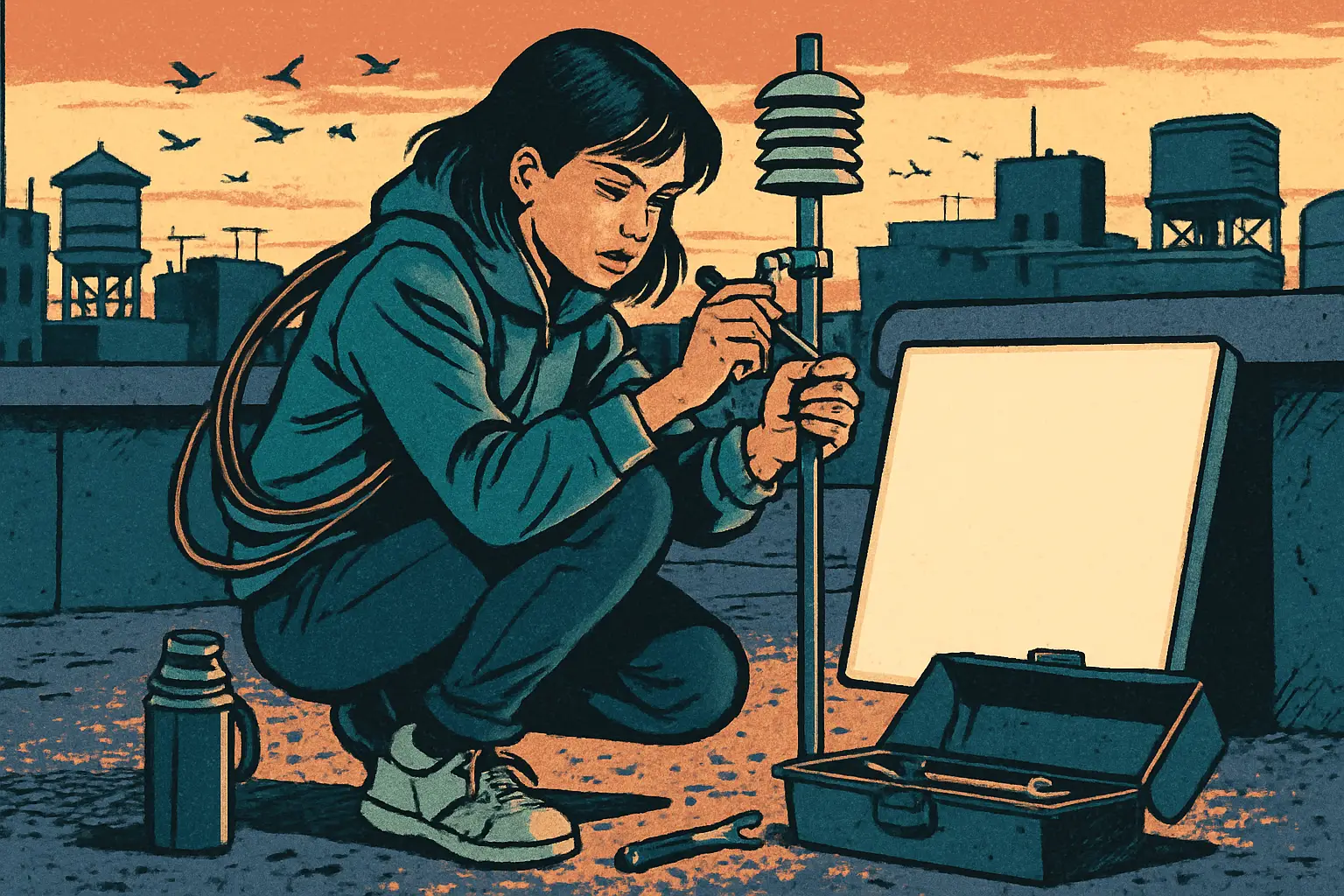
ESP32-P4 Weather Station Adds LoRa Air Quality Nodes
A DIY ESP32-P4 weather station drives a 10.1-inch touchscreen, LoRa sensor nodes and a SEN66 air quality sensor for roughly $185 in main-unit parts.

A Fully Local Weather Station Built on the ESP32-P4
Harald Kreuzer has published a complete build for a DIY weather station and air quality monitor centred on the ESP32-P4, and CNX Software wrote it up on September 3, 2026. The headline feature is not any single sensor — it is that the whole system runs without a cloud account. Weather API integration is optional, and every reading from the local sensor network stays on the device.
- Base unit: Waveshare ESP32-P4-Module-DEV-KIT-C with 32MB PSRAM and an onboard ESP32-C6 for wireless, driving a 10.1-inch 1280x800 IPS touchscreen
- Sensors: Sensirion SEN66 for PM1.0/2.5/4.0/10, NOx and VOCs, a BH1750 light sensor for auto-brightness, and a DFRobot C4001 24GHz mmWave presence sensor with 12m range
- Radio: a Heltec V4 board for LoRa, plus ESP-NOW for shorter-range nodes
- Cost: roughly $185 for the main unit, with the Waveshare board at $77.99 to $98.55 and the SEN66 at $62.03
How the LoRa Sensor Network Is Organised
The clever structural choice is separating the display unit from the sensing. The base station is a screen and a hub; the readings arrive from a fleet of small remote nodes over LoRa and ESP-NOW. Kreuzer has published firmware for several node types: BME280 temperature, humidity and pressure nodes on Heltec WiFi LoRa 32 V3/V4 and CubeCell boards, SHT45 temperature and humidity nodes, generic ESP32 ESP-NOW modules, and — the enjoyable outlier — a LoRa Geiger counter built around a RadiationD-v1.1 tube.
Splitting the roles this way solves the perennial DIY weather station problem, which is that the best place to measure the weather is rarely the best place to look at a screen. LoRa's range means an outdoor node can sit in a shaded, ventilated spot well away from the house while the display stays indoors, and battery-powered CubeCell nodes can run for months on that duty cycle.
If you want to go deeper on the radio side, our Raspberry Pi LoRa boards guide covers the same trade-offs from the Pi end of the ecosystem.
What Does the ESP32-P4 Bring to a Maker Project?
The ESP32-P4 is Espressif's RISC-V application processor, and its distinguishing feature is a proper MIPI DSI display interface. That is what lets this build drive a 10.1-inch 1280x800 panel at 400 cd/m2 directly — a resolution that is well out of reach for the ESP32-S3 class of parts that most maker dashboards run on.
The 32MB of PSRAM on the Waveshare module is the other enabling detail. LVGL with a framebuffer at that resolution needs real memory, and the interface here is built in LVGL with layouts designed in EEZ Studio, an open source GUI editor. The main unit and receiver firmware use ESP-IDF; the CubeCell sensor nodes use Arduino via PlatformIO.
We have watched this part earn its place all year, from the $45 ESP-KVM IP KVM to a BasiliskII port running classic Mac OS on a $40 devkit. A 10-inch touch dashboard is squarely in its wheelhouse.
Weather APIs Are Optional, Not Required
Three providers are supported for forecast data — Open-Meteo, OpenWeatherMap and Visual Crossing — and all three are optional. Open-Meteo in particular needs no key for non-commercial use, which keeps the whole build free of accounts if you want it that way. The local sensor readings work regardless.
The mmWave presence sensor is a small but well-judged addition: the display can wake when someone walks up and sleep when the room empties, which matters for a panel that would otherwise glow at a wall all night. The BH1750 handles brightness so the screen is not blinding at 3am.
Building One Yourself
All firmware lives in the creator's public GitHub repositories, covering the base station, the receiver module and each sensor node. Enclosures are 3D printed, with SolidWorks and STEP files included in the firmware repository — STL files for the current variant had not been released at the time of writing, which is the one gap if you want to print without CAD work.
Kreuzer notes a follow-up variant based on integrated 10-inch GUITION ESP32-P4 touchscreen displays, which would fold the panel and the board into one unit and cut both the wiring and the enclosure complexity. For anyone browsing our mini computer coverage for a weekend build with a genuinely useful end product, this is a strong candidate — and it pairs neatly with the air quality monitoring hardware we have covered before.
Sources: CNX Software — September 3, 2026; Waveshare — ESP32-P4-Module-DEV-KIT-C — September 3, 2026.
More Mini Computers Stories
Xerxes Pi 2026 and Nano: A $49 Raspberry Pi CM5 Homelab Kit
Xerxes Pi 2026 and Xerxes Nano bring NVMe, PoE+ and OCuLink to Raspberry Pi CM5 and Jetson modules, with Kickstarter rack kits starting at $49.
Adafruit Floppsy Rev D: An RP2350 Floppy Disk Archiver
Adafruit Floppsy Rev D uses a Raspberry Pi RP2350 with 8MB PSRAM and a 2.8-inch touchscreen to image and emulate PC and Apple II floppies without a PC.
M5Stack PaperDIY: A $25 ESP32-S3 E-Paper Kit You Assemble
M5Stack PaperDIY packs a 4.7-inch 960x540 e-paper panel, an ESP32-S3 with 8MB PSRAM and a battery into a $25 kit that you put together yourself.