
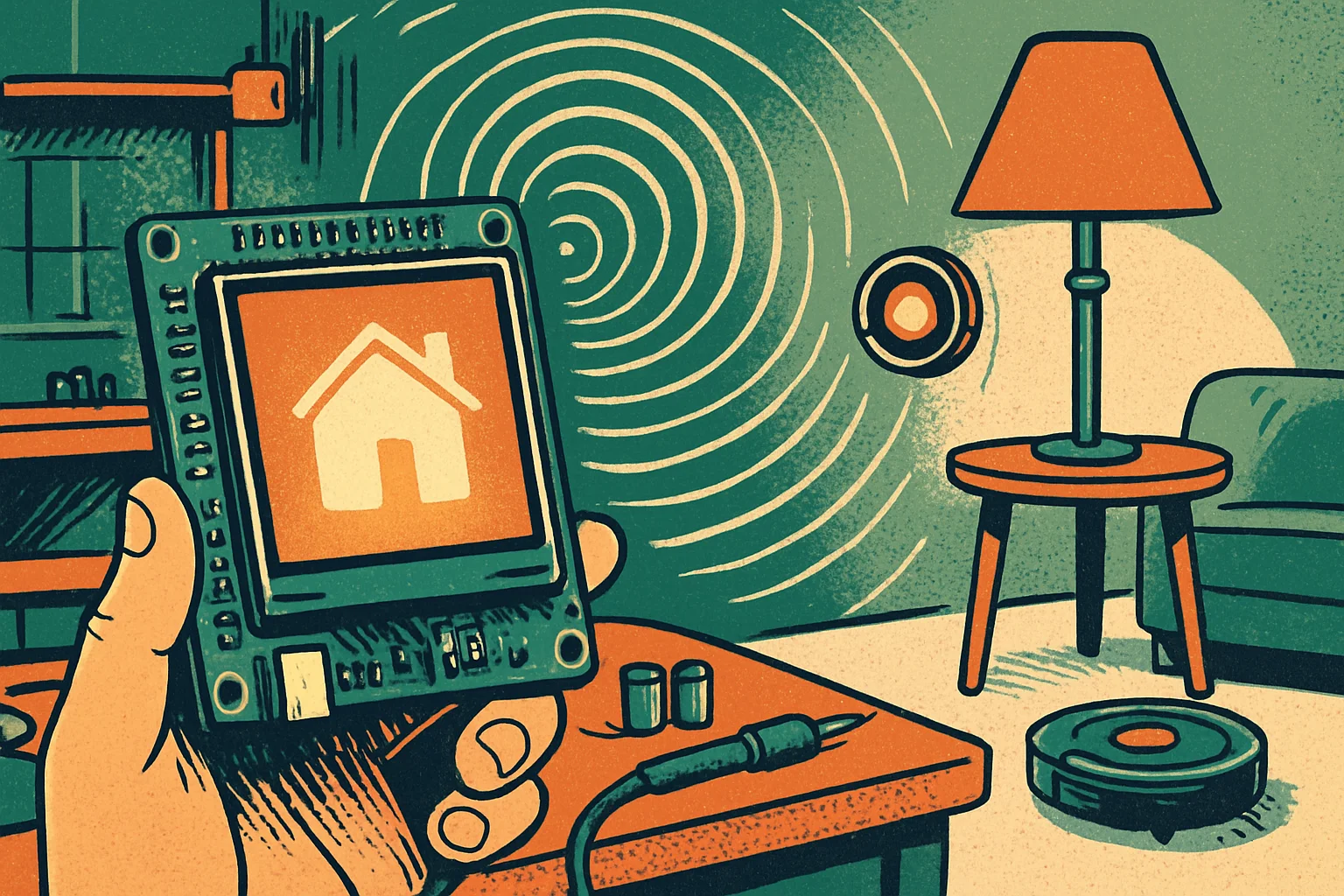
ESP32-C5 Devkits Bring Dual-Band Wi-Fi 6 to Cheap Maker Boards
The ESP32-C5 is Espressif's first dual-band Wi-Fi 6 chip, and fresh touchscreen devkits are putting 5 GHz connectivity in makers' hands for under $40.

The ESP32-C5 Just Made 5 GHz Wi-Fi Affordable for Everyone
Here is a spec sheet worth getting excited about. The ESP32-C5 is Espressif's first system-on-chip to speak dual-band Wi-Fi 6, meaning it hops between the crowded 2.4 GHz band and the roomier 5 GHz band, and it does it with genuine 802.11ax support. Pair that with Bluetooth 5 Low Energy and you have a connectivity package that used to be reserved for pricier gear. Now it is landing on ready-to-use dev boards you can order for the cost of a couple of pizzas.
For makers, the headline is simple: 5 GHz Wi-Fi 6 has arrived at hardware-store prices. That is not a small thing. Let me walk through why the specs matter and what the new boards actually give you.
Why Dual-Band Wi-Fi 6 Changes the Math
Every previous mainstream ESP32 lived on 2.4 GHz alone. That band is fine for a single sensor blinking a reading every few minutes, but it is also where your microwave, your neighbor's router, and every other smart gadget in the building are all shouting at once. The 5 GHz band is far less congested and carries data faster over shorter ranges, which is exactly the profile of a home-automation node sitting in the same room as your access point.
Wi-Fi 6 adds its own tricks on top. Features like OFDMA and target wake time let many devices share airtime more efficiently and let battery-powered nodes sleep longer between check-ins. For a dense smart home packed with dozens of little gadgets, that translates to steadier connections and better battery life. The ESP32-C5 brings all of this to a chip you can drop into a hobby project.
The Boards Making It Real
The most eye-catching option is Waveshare's ESP32-C5-Touch-LCD-2.8. It wraps the new chip in a proper human-machine interface: a 2.8-inch capacitive touchscreen at 320x480 resolution, onboard audio, a handful of sensors, and LiPo battery support so your build can run untethered. Pricing runs roughly $25.99 to $37.99 depending on configuration, which is remarkable for a touchscreen IoT device kit with this radio inside.
That touchscreen is the real story for HMI projects. Instead of squinting at a two-line character display or reaching for your phone, you can build a wall-mounted thermostat, a lighting controller, or a status dashboard with a responsive graphical interface baked right in. The battery support means it does not have to be chained to a wall outlet.
A second board that surfaced on July 3 takes a leaner approach, pairing the ESP32-C5 with a compact 1.47-inch color LCD. It is one of the first ESP32-C5 IoT boards to reach the market, aimed at builders who want the new connectivity in a smaller, simpler package for embedded gadgets and wearable-scale projects.
What to Build First
If you have been running smart-home nodes on aging 2.4 GHz boards and fighting dropped connections, the ESP32-C5 is a clean upgrade path. The dual-band radio gives you a fallback when one band is congested, the Wi-Fi 6 efficiency features stretch battery life, and the touchscreen variant hands you a real control surface without extra parts. For makers, this is the kind of quiet, meaningful hardware jump that opens up projects that simply were not practical before at this price. Order one, flash your firmware, and enjoy the elbow room on 5 GHz.
Sources: CNX Software (cnx-software.com), July 7, 2026.
More Mini Computers Stories

Raspberry Pi 5 Cluster Runs Qwen3-30B at 15 Tokens a Second
Four 16GB Raspberry Pi 5 boards ran Qwen3-30B-A3B at 15.1 tokens per second on CPU alone, a 16% gain over the prior record with distributed-llama.
DSPi Firmware Turns a Raspberry Pi Pico Into a USB DSP Card
DSPi firmware turns a Raspberry Pi Pico or Pico 2 into a USB sound card with up to 110 EQ bands, active crossovers and room correction. Open source.

Raspberry Pi Desktop for PC and Mac: Revive an Old Laptop
Raspberry Pi Desktop returns for PCs and Intel Macs on 64-bit Debian Trixie, runs live from USB, and installs free on machines up to about 15 years old.