
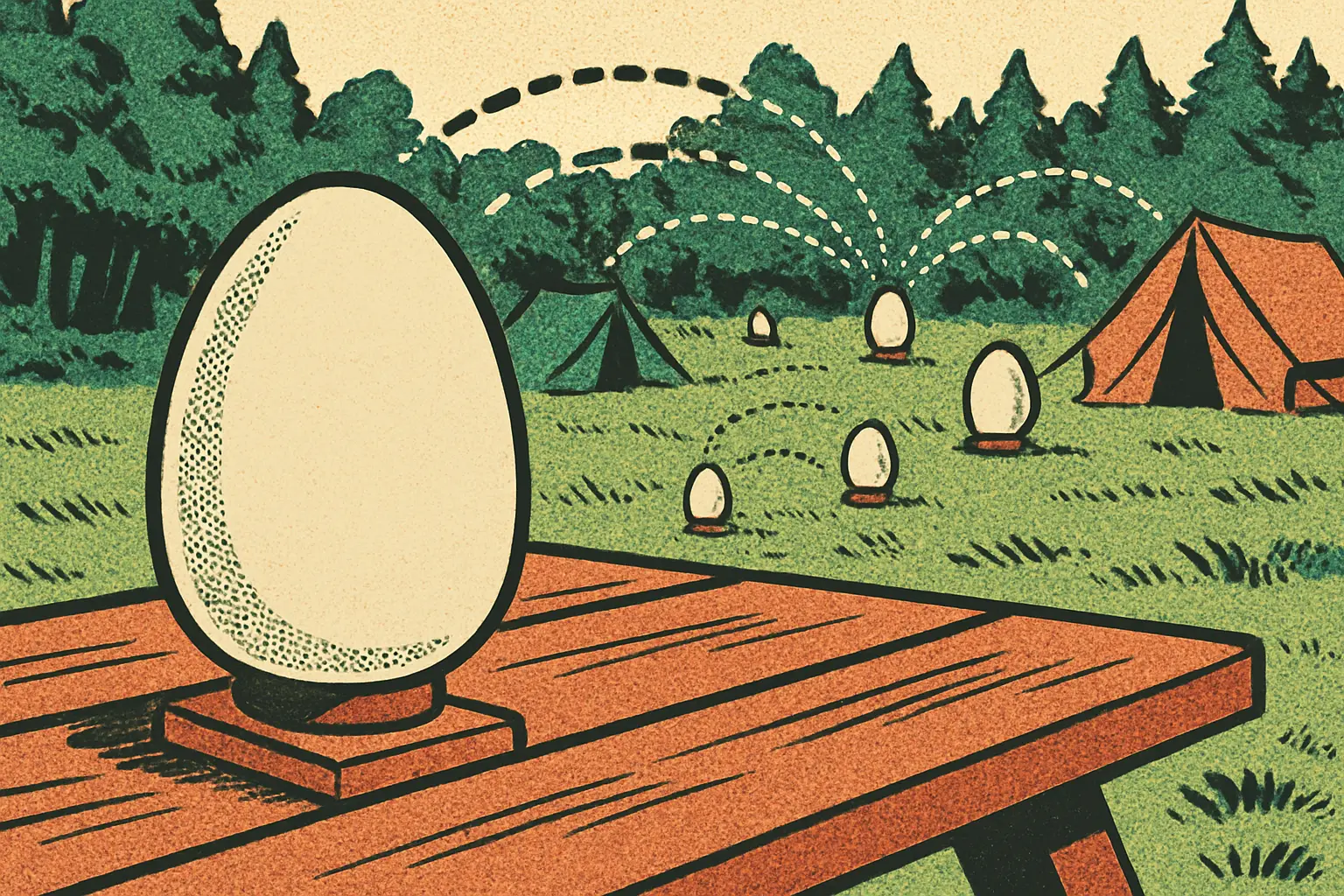
BornHack's Cyber Aegg Badge Runs LoRa Mesh Networking
The BornHack 2026 Cyber Aegg badge pairs an nRF52840 with an SX1262 LoRa radio and a 1.54-inch e-paper display, and it lasts the whole camp on one charge.

A Conference Badge Built to Outlive the Conference
Event badges have a predictable arc: impressive on day one, novelty by day three, drawer by the following month. The BornHack 2026 badge - the Cyber Aegg - was designed against that outcome. As covered by Hackaday on July 17, 2026, it is an egg-shaped, open source device built around a Nordic nRF52840 and a dedicated LoRa radio, with a 3D-printed case whose flat base lets it stand on a desk as a clock and calendar long after the camp packs up.
Key Takeaways
- The Cyber Aegg pairs a Nordic nRF52840 MCU with a dedicated Semtech SX1262 LoRa radio that joins the wider MeshCore network.
- A 1.54-inch black, red, and white e-paper display is the reason the badge is designed to run the entire BornHack camp on a single battery charge.
- Expansion covers a QWIIC-style I2C connector, BLE to a phone, and NFC tag emulation on the rear of the badge.
- Hardware design and firmware are both open source and hosted on Codeberg, produced with the European badge-making collective badge.team.
The Hardware
The Nordic nRF52840 is a sensible choice for a badge: Cortex-M4 class performance, a mature Bluetooth LE stack, and low-power behaviour that is well understood by the people most likely to hack on it. BLE handles the link to a phone.
The more interesting radio is the separate Semtech SX1262 dedicated to LoRa. Rather than making the badge a self-contained island, that radio joins the wider MeshCore network, meaning badges relay for each other and the mesh extends across the camp without any infrastructure being deployed. Using a dedicated LoRa part rather than trying to make one radio do everything is the right engineering call - it means mesh traffic is not competing with the phone connection for airtime.
Display and Power Budget
The screen is a 1.54-inch e-paper panel in black, red, and white. E-paper is the decision that everything else follows from: it draws power only when the image changes, which is what makes the stated goal - running the entire BornHack camp on a single battery charge - achievable. A colour LCD badge with the same battery would be dead by lunchtime on day two. The red channel is a nice touch for a three-colour panel, giving alerts and highlights somewhere to live without resorting to inverted blocks.
Expansion and Interfaces
The rear of the badge emulates an NFC tag, which makes badge-to-phone interactions and identity tricks straightforward. For hardware hacking there is a QWIIC-style I2C expansion connector, so the enormous existing catalogue of QWIIC and STEMMA QT sensors plugs straight in with a single cable. That connector is what turns the badge from a fixed-function gadget into a platform - a sensor, a display driver, and a mesh radio in one hand-sized package.
What Does the Badge Actually Run?
The shipped software leans into the event experience. There is BornPets, a Tamagotchi-style virtual pet with mini-games, plus an event calendar so attendees can see what is on next, and an RFID token game that turns the camp into a scavenger hunt. Those are the features that make people carry the badge for four days rather than leaving it in a tent, and carrying it is what keeps the mesh dense.
All of it is open source. Both the hardware design and the firmware are hosted on Codeberg, which means the badge is a documented reference design for anyone who wants to build a LoRa mesh node with an e-paper front end. Combined with the QWIIC connector, that is a genuinely useful starting point for a homelab sensor project independent of the event entirely.
The Anti-E-Waste Angle
The design choice that deserves the most credit is the case. It is 3D printed in an egg shape with a flat base, so the badge stands upright on a desk. Paired with the e-paper display and the low power draw, that turns it into a working desk clock and calendar after the event ends - a badge with a life afterwards rather than another piece of conference e-waste.
This matters more than it sounds. The hardware in a typical event badge is perfectly capable of years of useful service; what kills it is the absence of any second role. Giving it a shape that sits on a desk and firmware that shows the date is a very small amount of design effort for a very large change in outcome. The badge was produced with badge.team, the European badge-making collective, whose accumulated experience in exactly this kind of design shows in the result.
Building Something Similar
If the combination appeals, the pieces are all available off the shelf. An nRF52840 module, an SX1262 LoRa radio, and a small e-paper panel is not an exotic bill of materials, and the Codeberg repositories give you a known-good reference for how they fit together. The ESP32 wM-Bus gateway for Home Assistant build covers the low-power radio side in detail if you want to construct the gateway end of the link, and the wider mini computers section tracks the small-board field these designs draw from. For another take on compact open hardware, the Moddo Pinch, the smallest 32-bit Arduino board is worth a look.
The Cyber Aegg is a small, well-judged piece of hardware design - the right radio for the job, a display that respects the power budget, an expansion connector that opens it up, and a case that gives it somewhere to go afterwards.
Sources: Hackaday - July 17, 2026; Badge.Team - July 17, 2026.
More Mini Computers Stories
Xerxes Pi 2026 and Nano: A $49 Raspberry Pi CM5 Homelab Kit
Xerxes Pi 2026 and Xerxes Nano bring NVMe, PoE+ and OCuLink to Raspberry Pi CM5 and Jetson modules, with Kickstarter rack kits starting at $49.

Adafruit Floppsy Rev D: An RP2350 Floppy Disk Archiver
Adafruit Floppsy Rev D uses a Raspberry Pi RP2350 with 8MB PSRAM and a 2.8-inch touchscreen to image and emulate PC and Apple II floppies without a PC.

M5Stack PaperDIY: A $25 ESP32-S3 E-Paper Kit You Assemble
M5Stack PaperDIY packs a 4.7-inch 960x540 e-paper panel, an ESP32-S3 with 8MB PSRAM and a battery into a $25 kit that you put together yourself.