
Anthropic's Claude Science: An AI Workbench Built for Researchers
Anthropic's Claude Science is an AI research workbench that unifies scientific tools and prioritizes full reproducibility, from genomics to drug discovery.

Claude Science: One Workbench for Scattered Research Tools
On June 30, 2026, Anthropic released Claude Science, and it is worth being precise about what it is: not a new model, but an AI *workbench*, sometimes called a harness, designed for working researchers. If you have ever watched a scientist juggle a dozen half-connected tools across genomics, proteomics, and cheminformatics, you already understand the problem Claude Science is trying to solve. It gathers those scattered tools into a single workspace so the researcher can spend less time gluing software together and more time thinking.
Think of it less like a smarter calculator and more like a well-organized laboratory bench where every instrument is finally within arm's reach.
What Ships in the Box
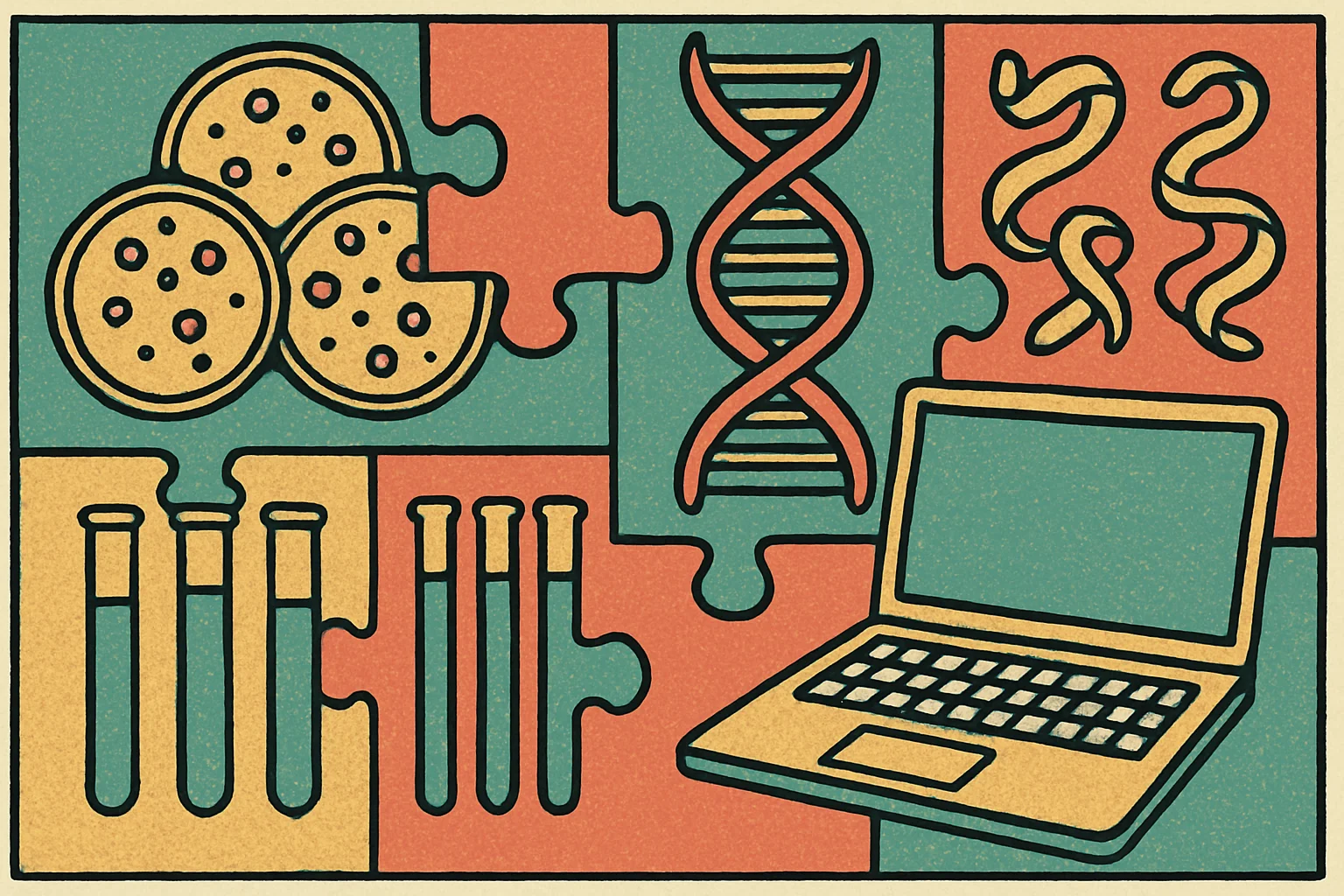
Claude Science arrives with more than 60 scientific databases and toolkits spanning genomics, proteomics, structural biology, single-cell biology, and cheminformatics. That breadth matters. Real biological questions rarely stay inside one discipline; a question about an enzyme's stability might reach into structural biology, chemistry, and cell biology at once. By unifying these domains, the workbench lets a researcher follow a question wherever it leads without switching contexts or re-formatting data by hand.
A Drug-Discovery Campaign From a Single Sentence
The launch demonstration is the part that made me sit up. From a single sentence of instruction, Claude Science planned and ran a drug-discovery campaign aimed at stabilizing the enzyme behind phenylketonuria (PKU), a metabolic condition. It screened 2,200 compounds across 80 GPUs and narrowed the field to four candidates.
I want to be careful here. This is a demonstration, not a cure. But it illustrates something important about acceleration: the slow, laborious scaffolding of a screening campaign, the planning, the orchestration, the bookkeeping, can be compressed dramatically, freeing scientists to focus on judgment and interpretation.
Why Reproducibility Is the Real Headline
For me, the most exciting design choice is not the speed. It is that every figure Claude Science generates ships with the exact code that produced it, the computing environment it ran in, and the full message history behind it. In other words, every result comes with its own complete lab notebook.
Reproducibility is a long-standing challenge across the sciences. A striking result is only as valuable as another lab's ability to reproduce it, and too often the trail of exactly *how* a figure was made goes cold. By bundling code, environment, and reasoning with each output, Claude Science treats reproducibility as a default rather than an afterthought. That is the kind of quiet, structural improvement that compounds over years.
How Researchers Can Get Access
Claude Science is available in beta to all paid subscribers, so most working researchers can begin experimenting immediately. Anthropic has also opened applications, open through July 15, 2026, through which up to 50 selected projects will each receive roughly $30,000 in credits to pursue more ambitious work.
What I find genuinely encouraging is the direction of travel. Tools like this do not replace the scientist; they remove friction. When the tedious parts of research shrink, curiosity gets more room to run, and that is how discovery accelerates.
Sources: Anthropic News (June 30, 2026); MIT Technology Review (June 30, 2026).
More AI Stories

Strands Decider 2B: What Amazon's Free Decision Model Does
Strands Decider 2B is a free 2B-parameter decision model that picks options in about 115ms on a single GPU. Here is how it works and where it fits.
Meta Muse Gadgets SDK: Build Your Own AI Agent Hardware
Meta's open-source Muse Gadgets SDKs bring its Muse agent to Raspberry Pi and ESP32 builds, and 5,000 free Home Link dongles are going to subscribers.

AstaBrief 8B: Ai2's Open Model for Cited Science Reports
AstaBrief 8B is Ai2's Apache 2.0 open model that writes cited research reports in 51 seconds, 3.5x faster than its Claude pipeline. Here is how it works.