
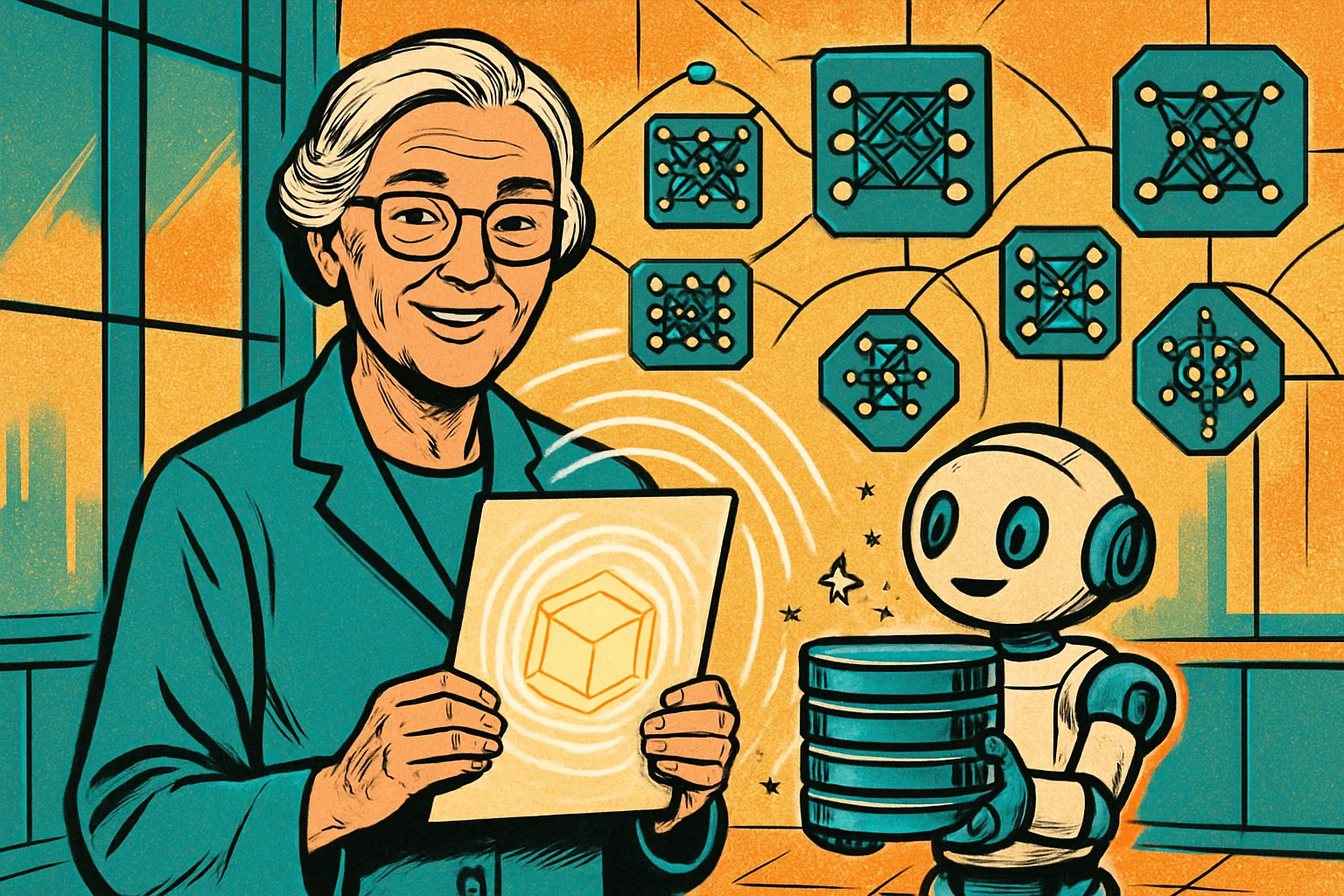
Andrej Karpathy Joins Anthropic — The OpenAI Co-Founder Brings Pretraining Star Power to Claude
Andrej Karpathy, OpenAI co-founder and former Tesla AI director, joined Anthropic on May 19, 2026 — he will work on the Claude pretraining team and help launch a new group using Claude to accelerate pretraining research itself.

A Generational AI Researcher Lands on the Claude Pretraining Team
On Tuesday, May 19, 2026, Andrej Karpathy — one of the original 11 co-founders of OpenAI, the former director of Tesla's Autopilot AI team, and one of the most beloved educators in modern machine learning — announced that he has joined Anthropic. He will sit on the Claude pretraining team, the group responsible for the massive training runs that shape the model's core capabilities, and will also help spin up a new initiative focused on using Claude itself to accelerate pretraining research. For anyone tracking the frontier of large language model development, this is one of the most significant individual hires in the field this year.
Anthropic's Head of Pretraining, Nicholas Joseph, framed the move on Tuesday morning as a strategic step that pairs Karpathy's deep instinct for what makes neural networks actually learn with the company's existing emphasis on rigorous, scaled-up training methodology. Karpathy's own short note read: "Personal update: I've joined Anthropic. I think the next few years at the frontier of LLMs will be especially formative. I am very excited to join the team here and get back to R&D." He added that he plans to return to his long-running education work over time, which is the part of the announcement the broader AI community is most quietly thrilled about.
Why Karpathy Joining the Claude Pretraining Team Matters
The Claude pretraining team is where the foundational character of the model gets built. The data curation choices, the optimizer dynamics, the curriculum design, and the small architectural decisions made during pretraining shape every downstream capability — from instruction following to coding ability to long-context reasoning. Karpathy spent the last decade building intuitions for exactly these decisions: first as one of the OpenAI co-founders working on the early GPT family, then as the leader of Tesla's vision and Autopilot training infrastructure, and most recently through his independent research and education work at Eureka Labs.
The Specific Expertise Karpathy Brings to Claude
Karpathy's published work spans the full pretraining stack — tokenizers, attention variants, learning rate schedules, dataset hygiene, mixed-precision arithmetic, and the practical engineering tradeoffs that separate a training run that converges cleanly from one that quietly underperforms. The nanoGPT, llm.c, and minbpe reference implementations he released over the past two years are exactly the kind of clean, instructive codebases that translate directly to the largest training jobs. Anthropic's pretraining group gets a senior researcher whose mental model of LLM training is unusually complete.
The New Team Using Claude to Accelerate Pretraining Research
The second piece of the announcement is structurally even more interesting: Karpathy will help launch a new team focused on using Claude as an active research collaborator inside the pretraining process. The idea is to let Claude itself analyze training-run telemetry, propose ablations, draft experimental protocols, write the supporting tooling, and review the resulting metrics. The pretraining group has historically been the slowest, most expensive, and most experiment-bound part of an AI lab — accelerating its inner loop with a frontier model that already understands the relevant literature is the kind of compounding move that pays back for years.
Why This Is the Right Application for Claude
Pretraining research is the part of AI engineering where small, well-reasoned decisions compound into very large outcomes. The questions are highly technical, the literature is dense, and the experimental cycle is long. A frontier model that can read the latest papers, propose informed hypotheses, write the analysis scripts, and reason about distributed training dynamics is exactly the kind of collaborator that accelerates a senior researcher rather than replacing one. Karpathy leading the team that builds that workflow is the right pairing of talent and ambition.
The Broader Talent Story for Anthropic
Karpathy's move is the latest in a series of high-profile researcher moves that have steadily strengthened Anthropic's research bench through 2026. The company has consistently positioned itself as the lab where the small, brilliant, deeply technical research culture remains intact at scale — and the talent flow has followed. Bringing Karpathy onboard is a particularly clear signal because he has been one of the most independent and most respected voices in the field. His decision to move out of independent research and into Anthropic's pretraining work tells the rest of the community where the most interesting LLM research problems live in 2026.
The Education Promise Is the Hidden Bonus
Karpathy noted in his announcement that he plans to resume his education work in time. For the millions of developers and learners who have learned the modern ML stack from his YouTube lectures, his GitHub repos, and his blog posts, that line is the part of the announcement worth highlighting. The educational artifacts that come out of a senior Anthropic researcher working at the cutting edge of LLM pretraining and choosing to share them publicly are exactly the kind of public good that the broader ML community benefits from for decades.
What This Means for the Frontier in 2026
For anyone tracking the LLM frontier, the Karpathy-to-Anthropic move is the kind of signal that shapes expectations for the next generation of Claude models. The pretraining team gets a researcher with a uniquely deep practical instinct for training dynamics. The new Claude-assisted research team gets a thoughtful leader who has already publicly modeled what good research workflow looks like. The broader AI community gets a renewed promise of educational content from one of the field's best teachers. And Anthropic gets a public statement, in the form of a single hiring announcement, that the lab remains the place where frontier LLM research and a coherent research culture continue to compound.
For developers building on Claude, the practical read is that the model series gets a new top-tier researcher driving the foundation it all sits on. For the broader AI ecosystem, the read is that the talent war for the next phase of LLM research is being won by labs that take both research and culture seriously. And for everyone who follows Karpathy's work, the read is the simplest of all — one of the field's best is back at the frontier, and the next chapter is going to be a fascinating one to watch.
Sources: VentureBeat, May 19, 2026; Axios, May 19, 2026; Reuters via TradingView, May 19, 2026; Washington Times, May 19, 2026.
More AI Stories

Gemini Agent for Work: What Google's Universal Agent Does
Google's new Gemini agent runs multi-day jobs in the cloud, routes work across Gemini and Claude models, and adds hard spend caps for business teams.

Liquid AI d1 Models: Open Decision AI That Answers in 8 ms
Liquid AI's open d1-3B and d1-omni-600M decision models skip token generation and answer in one pass, as fast as 8 ms on an RTX 4090 and 50 ms on Jetson.

Claude Haiku 5.5 Pricing: What a 90% Cheaper Haiku Unlocks
Claude Haiku 5.5 launches at $0.10 per million input tokens with a 1M context window, adjustable effort, and a 72.4% OSWorld score, up from 15.7%.